
Montgomery County Wanted Fugitives
The Sheriff's Office does not keep its own fugitive page. Instead, it points visitors to the Central Alabama CrimeStoppers wanted list. Think of it as a regional photo bulletin. Agencies behind the notices have included the Montgomery Police Department, the Montgomery County Sheriff's Office, and the U.S. Marshals Service, so the faces there can involve county, regional, or federal cases. The image shown is not always a Mac Sim Butler Detention Facility booking photo. Notices can also stay up for years, since CrimeStoppers sets no fixed refresh schedule. Read each entry carefully. Check its requesting agency and wanted date before deciding how current it is.
Montgomery County Wanted Listing Fields
CrimeStoppers notices are not uniform records. Some are rich in detail, while others show only a few fields. The requesting agency supplies the useful context. Readers should not fill a blank with an assumption or identify someone from a face alone. Names, dates of birth, physical descriptions, case numbers, and the agency named on the notice help reduce the risk of confusing two people.
| Field | What it shows |
|---|---|
| Name and photograph | The identity and image published by the requesting agency; the image source may vary. |
| Alleged offense | The stated reason the person is sought, not a conviction or final court disposition. |
| Wanted-as-of date | The date attached to the notice, which may be much older than the viewing date. |
| Demographics | When supplied, age or birth date and height, weight, or other descriptors used to distinguish namesakes. |
| Case and agency | The case number and MPD, MCSO, USMS, or other agency asking for information. |
| Caution or reward | Safety language and any case-specific reward statement; not every notice offers the same terms. |
Last-known-address text is a historical lead, not proof of a person's present location or residence. Narrative details may also describe an agency's allegation. They should be passed to investigators, not treated as permission for public enforcement.
Read Montgomery County Wanted Notices
The safest use of a wanted list is narrow: confirm the notice, note which agency requested it, and send a tip without placing anyone at risk. CrimeStoppers keeps the photographs on its own page, which allows the source notice to carry its date, caution text, and case details together.
- Open the official MCSO-linked CrimeStoppers page and read the complete notice, including the requesting agency and wanted-as-of date.
- Compare written identifiers. Do not rely on a photograph alone, and do not circulate a claim that goes beyond the notice.
- If the sighting is current, move to safety. Do not make contact or attempt to confirm identity in person.
- Send the location, time, direction of travel, and other direct observations through an approved tip route.
- Keep the anonymous Tip ID and password if CrimeStoppers issues them, since they support follow-up without disclosing identity.
After law enforcement reports an arrest, the county's Montgomery County booking and current-custody tools can show whether a Mac Sim Butler intake record exists. A missing roster result is not proof that no arrest occurred. Another jail, a federal agency, release after booking, or a posting delay can produce a different result.
For a source-view example, the regional wanted page is captured below without rehosting individual booking photographs as a gallery.
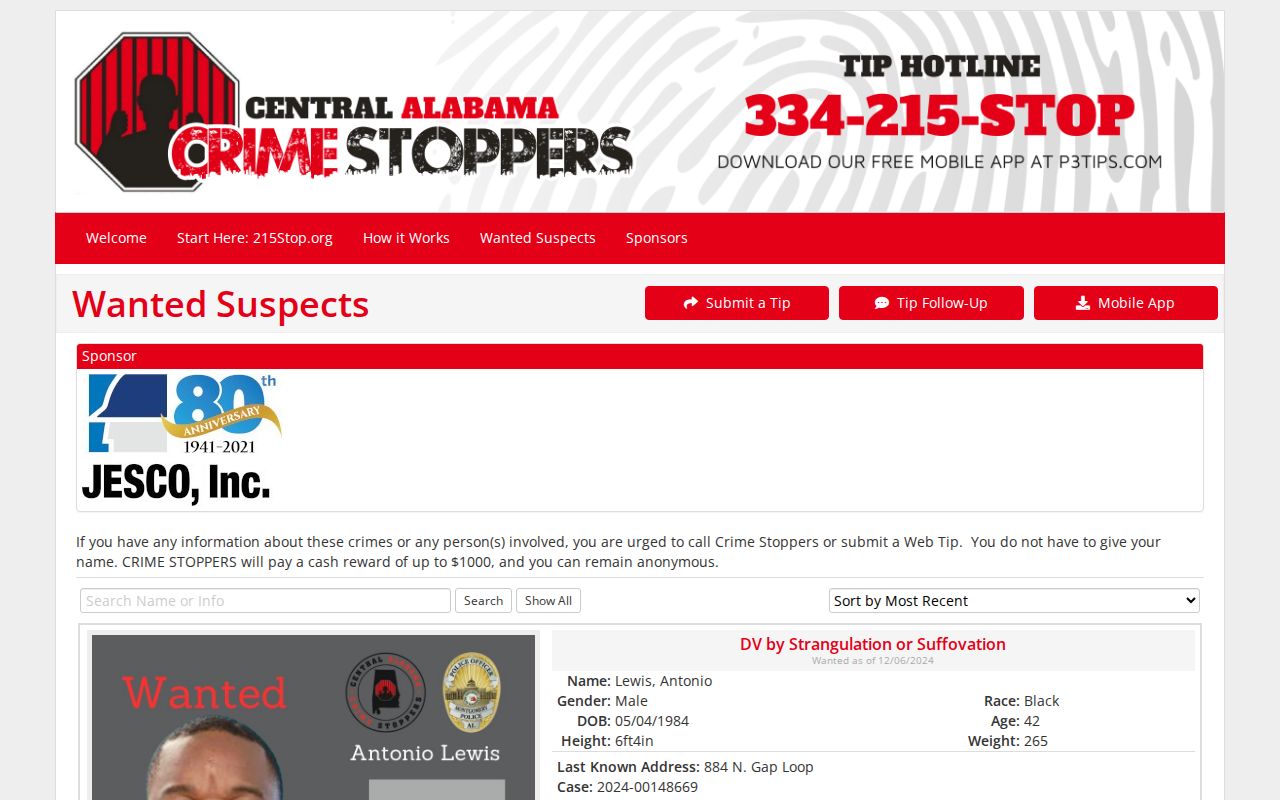
The capture documents the official access route and selected-list format; the live source should be checked for current notices and agency instructions.
Note: A later booking and a wanted notice are separate records, and neither supplies the final result of a criminal case.
Montgomery County CrimeStoppers Tips
Central Alabama CrimeStoppers accepts tips by local and statewide phone lines, text, its online form, and the P3 Tips app. The service describes participation as anonymous. A tipster who wants to check for follow-up should retain the assigned credentials because investigators cannot restore an anonymous account by name. Reward availability and amount vary by case, and submitting information does not guarantee a payment.
Central Alabama CrimeStoppers
Local: 334-215-STOP (7867)
Statewide: 1-833-AL1-STOP
Text 215stop to 738477
CrimeStoppers is for investigative information, not warrant confirmation. Provide what was directly seen or heard and let the named agency assess it. For an immediate danger, call 911 rather than wait for an anonymous-tip response.
Montgomery County Warrants Versus Wanted
Montgomery County has two unusually distinct tools. The small CrimeStoppers list is curated for public attention. The official outstanding-warrant portal is a broad name-and-number database. It showed 12,248 rows when researched, compared with 16 selected CrimeStoppers notices. Those counts are dated snapshots, but the scale difference explains why most searchable warrants should not be expected on the wanted page.
The warrant portal shows full name, date of birth, warrant number, and issue date. An opened detail may add physical descriptors and charge information. Its issue date tells when the process began, not whether it remains active at the exact moment of a search. MCSO says the records-management system is updated when warrants are issued, recalled, or served, yet the Warrant Office or issuing court remains the confirmation point.
| Tool | Scope | Best use |
|---|---|---|
| CrimeStoppers wanted list | Selected regional notices from multiple agencies | Recognizing a highlighted subject and safely sending a tip |
| MCSO warrant portal | Searchable outstanding-process records | Checking a name or known warrant number, then confirming officially |
Check Montgomery County Warrants
A warrant is a court-authorized direction for law enforcement action. A portal match is important, but common names, stale display, and later court action make verification essential. Someone who thinks a Montgomery County warrant may apply to them should avoid informal advice and arrange a lawful response through an attorney or the issuing court.
- Search the official portal by warrant number when known. It is the most exact key.
- If using a name, enter the least ambiguous first and last name, then compare date of birth and identifiers carefully.
- Open the detail and note the warrant number, issue date, charge description, and named court or agency when supplied.
- Confirm status with the MCSO Warrant Office at 334-832-2579 or 334-832-1200, or with the issuing court.
- If the portal cannot resolve the question, use the county's official public-record request instructions and identify the person, warrant number, and record sought as precisely as possible.
- If the warrant may concern you, speak with counsel or the court about appearance, surrender, bond, and scheduling. Do not use search data to avoid service.
A warrant search tells you just one thing: process exists under a name. It cannot tell you whether the person has seen it. It cannot predict how a case will end.
Note: Record the warrant number and verify current status before acting, since results can shift after service or recall.
Montgomery County Warrant Types
Warrants in Montgomery County flow from several places. The MCSO Warrant Office holds process issued out of Circuit Court, District Court, and grand-jury matters. Which court issued the paper often matters more than the label on it. The next safe step depends on the court and the posture of the case.
| Type | Meaning in the record path |
|---|---|
| Arrest warrant | Authorizes an arrest based on an alleged offense and a judicial finding supporting issuance. |
| Bench warrant | Usually arises from a court proceeding, such as a missed appearance or failure to follow an order. |
| Grand-jury warrant | Relates to process issued after grand-jury action and maintained through the Warrant Office. |
| Recalled or served warrant | Process that should no longer be treated as outstanding after official status changes, subject to confirmation. |
Charge wording in a portal describes the basis for the warrant, nothing more. The Montgomery Circuit Clerk keeps the file that shows what actually happened in court.
Resolve Montgomery County Warrants
Start with two facts. You need the warrant number and the issuing court. A lawyer can pull the record, walk you through the procedures, and arrange an appearance or surrender. The issuing court itself will explain filing, calendar, and clerk requirements. MCSO can confirm its warrant-management status and point you the right way, though its word never substitutes for the court's case file.
Payment alone does not clear a warrant. Neither does an online message or a chat with some unrelated office. Get confirmation from the authority that issued it. If service ends in booking at Mac Sim Butler, the current-inmate or recent-arrest tool may later show intake details under a new number and timestamp.
The court file and the jail file move on different clocks. A warrant can be recalled before any portal catches up. So keep that warrant number, ask which court issued it, and rely on the court's current status rather than an old screenshot or wanted notice.
Montgomery County Sheriff App
One app puts the county's channels in a single pocket. The iOS listing and the Android listing cover inmate search, recent arrests, warrant search, most wanted notices, news and events, Amber alerts, sex-offender search, push notifications, and tip submission. One sheriff ecosystem spans custody, process, alerts, and tips, though the records stay separate.
Treat the app as a route to MCSO data, not a promised photo source. Social handles and campaigns shift over time. That makes the sheriff's official site and current app-store listings the safer starting points.